Straight to content
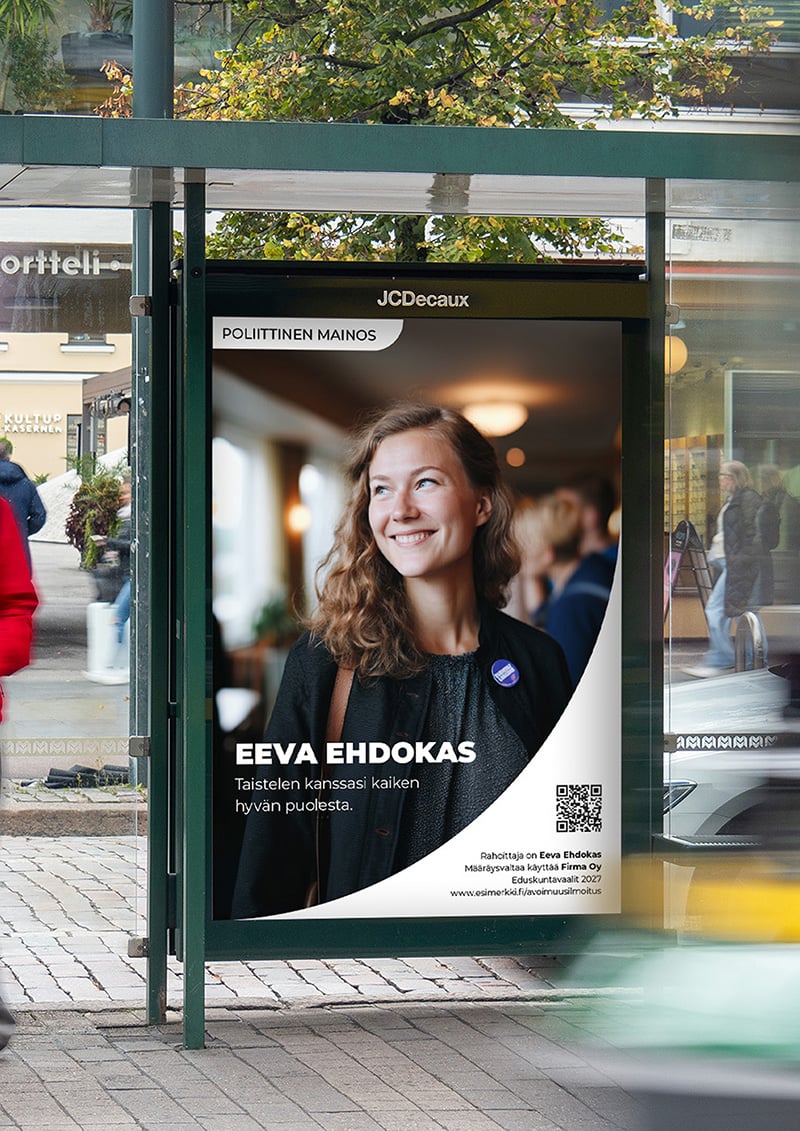
Esimerkki poliittisesta mainonnasta raikkapysäkillä.

Political and societal advertising

The European Union’s new Transparency and Targeting of Political Advertising (TTPA) Regulation will tighten the rules on political advertising in all member states from 10 October 2025 onwards.

The objective of the TTPA Regulation is to make political advertising more transparent than before and to ensure that citizens can clearly see who is financing the advertising and what the advertising relates to. The regulation increases openness, prevents abuses and hybrid influencing, and strengthens trust in democratic processes throughout the European Union.

Political and societal advertisers can continue to run campaigns in JCDecaux’s outdoor advertising network, taking into account the requirements of the Regulation.

Transparency notice

 Political and societal advertiser, remember to complete the Transparency notice well in advance before the start of the campaign.

What is political advertising?

Advertising is political when it is financed by a political actor themselves or by someone else on their behalf

OR

the message of the advertising is designed to influence voting behaviour or a legislative or regulatory process.

Examples of political advertising:

  • Campaigns by parties and candidates
  • A trade union campaign that advocates a change in the law
  • A company’s brand campaign that takes a stand on new regulation (e.g. climate, sugar tax, etc.)

What is non-political advertising?

Commercial campaigns: the sale of products and services, including cases where the profits are directed to charity.

General fundraising, where the purpose is to raise funds without social or political messages.

Advertising that does not take a stand on a societal issue or political decision-making.

Not considered political advertising:

  • Neutral information from public authorities about elections (e.g. how to vote)
  • General presentations by cities and municipalities or free advertising time
  • Opinions expressed by a private individual on their own initiative and without payment
  • Pure product or service advertising without a political purpose

Societal advertising

The Regulation is not limited only to advertising related to parties or candidates.
Societal advertising may also be covered by the Regulation if the aim of the communication is to influence political decision-making or public debate.

This means that:

  • Corporate responsibility campaigns may be subject to the Regulation if they address topics linked to politics, such as climate, equality or taxation.
  • Statements or positions that do not directly support a specific party or candidate may also constitute political advertising.
  • If communication is defined as political or societal advertising, the same transparency information as for election advertising must be presented in connection with the advertisement.

Restricted topics in societal advertising include:

  • Climate change campaigns
  • Discussions on immigration policy
  • Advocacy in favour of healthcare reform
  • Communication on taxation and economic policy
  • Themes related to social justice and human rights
  • Content that addresses politically sensitive or socially divisive topics

Ambiguity of interpretation

The following topics can be political or non-political depending on the content of the advertising:

  • Non-political, if it focuses solely on humanitarian aid and fundraising (food, clothes, medicine, etc.)
  • Political, if it refers to war, governments or foreign policy positions.

International theme days

  • Political, if the advertisement promotes equality policies or social justice.
  • Neutral acknowledgement of a celebration/day is non-political.

Charities

  • Political, if the message advocates social or political change.
  • General messaging about donating is acceptable as long as it has no political tone.
Esimerkki polittisesta ulkomainoskampanjasta metroasemalla.
poliittinen_mainos_pysty

Marking of political advertising

The advertisement must include the following information:

  • The text “POLITICAL ADVERTISEMENT” clearly and visually distinguishable.
  • The NAME OF THE FUNDER (business name or the first name and surname of a natural person) must be stated directly in the advertisement.
  • The NAME OF THE ENTITY EXERCISING CONTROL OVER THE FUNDER (business name or the first name and surname of a natural person) must be stated if the funder is under the control of an entity that has decisive influence over the composition, votes or decisions of its bodies (for example, the parent company of a group).
  • THE ISSUE, for example the elections (Parliamentary Elections 2027), referendum, legislative proposal or regulatory initiative to which the advertisement relates.
  • A LINK or QR code providing more detailed information about the advertisement, its funding and the payer.
NOTE: Without the required information, the advertisement cannot be published!
Esimerkki poliittissen mainosjulisteen merkinnöistä.

Example of marking advertisements

POLITICAL ADVERTISEMENT The funder is [name] Parliamentary Elections 2027 [web address of the transparency notice] or QR code

POLITICAL ADVERTISEMENT The funder is [name] Control is exercised by [name] Parliamentary Elections 2027 [web address of the transparency notice] or QR code

NOTE: The markings do not have to be in uppercase letters, but they must be clearly visible and stand out from the background of the advertisement.

The markings and the transparency notice (or the link or QR code to the transparency notice) must be presented in a single box that stands out from the background.

Transparency notice

The link or QR code shown in the advertisement must open the TRANSPARENCY NOTICE included in the political advertisement.

The transparency notice must include:

  • Contact details of the funder
  • Details of the payer of the advertisement, if different from the funder
  • The total monetary amount used for political advertising services
  • Information on the origin and total amount of the funds
  • A link to the official election or referendum information
  • Information about the reporting channel for notifying detected neglects/non-compliance
  • Information on the suspension/termination of the display of an earlier version of the advertisement
  • The number of views/reach of the political advertisement

Do you need assistance?

Ajankohtaista